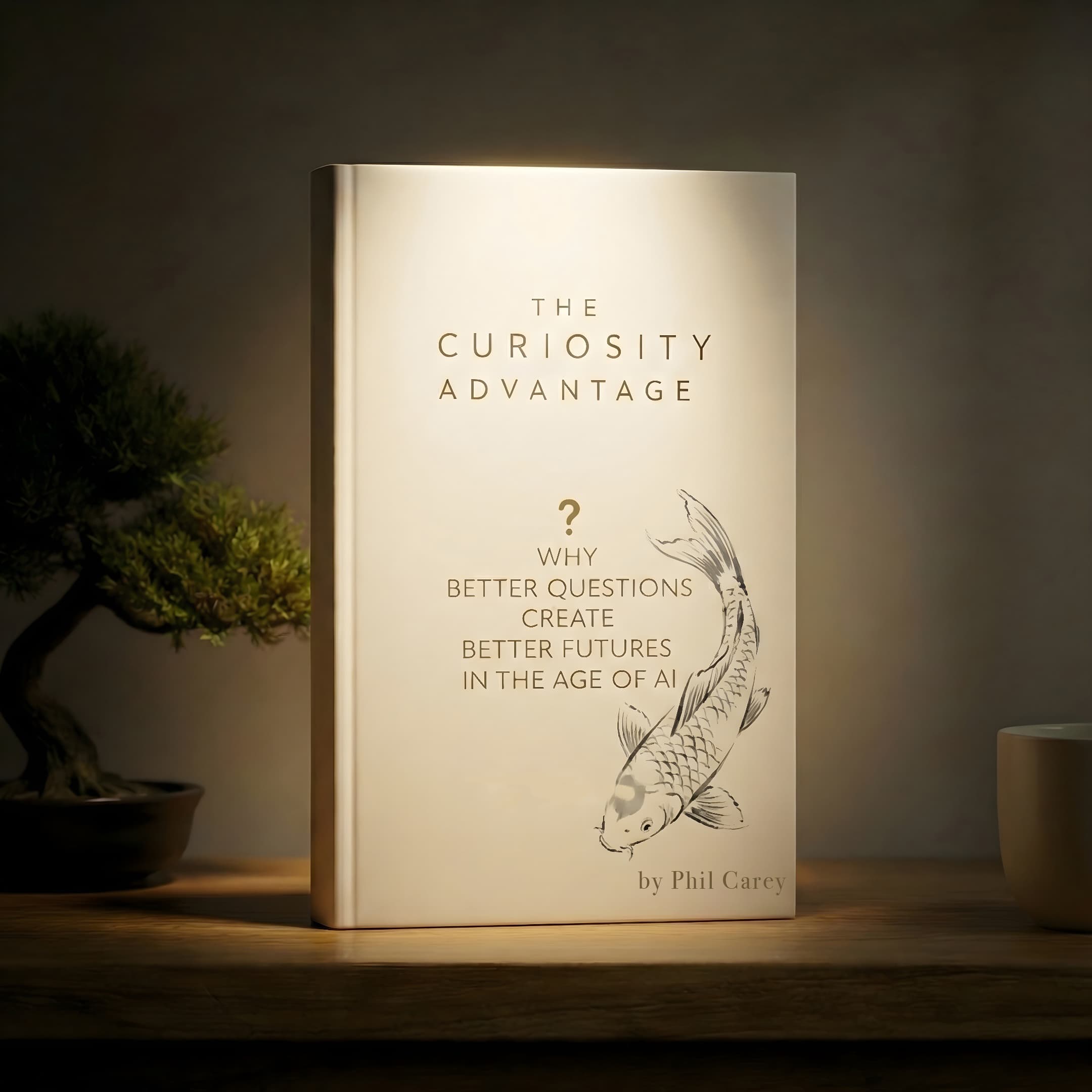
The Book
The Curiosity
Advantage
How Better Questions Create Better Futures in the Age of AI
The argument
Every question contains a frame. A belief, an assumption, an emotional lean. Most people never examine that frame. They treat a question as a doorway to an answer, rather than a structure that shapes what the answer can ever be.
When AI enters the picture, the consequences of your questions become visible in a new way. Ask a narrow question, and you get a narrow answer. Ask an open, exploratory question, and the conversation widens. Two people can sit with the same AI, ask about the same problem, and walk away with entirely different outcomes. Not because the AI changed. Because the question did.
The Curiosity Advantage is built on one distinction. The question is the lever. The future is the lift. Better questions produce sharper thinking, clearer choices, and smarter decisions. The compounding loop of asking, listening, and asking again is how real understanding takes shape.
This is not a book about prompts. It is about the psychology of working with AI as a thinking partner, and what becomes possible when you approach that relationship with genuine curiosity.
Phil wrote this book while building it. Each chapter emerged through collaboration with an AI, which meant the process itself became evidence for the argument. The questions he asked shaped what the book became. The book is not separate from its subject matter. It is made of it.
Across seven chapters, the book moves from the psychology of curiosity to the neuroscience of mindset, from the practical reality of job disruption to what it means to lead in an age when a machine can produce answers faster than you can form questions. The thread running through all of it: the people who do best with AI are not the ones who know the most about it. They are the ones willing to examine the way they think.
Who it is for
- —Leaders and executives who want to think more clearly about AI, not just move faster with it
- —Professionals whose work depends on good decisions, not just rapid outputs
- —Anyone curious about what changes when a thinking machine becomes part of how you work
- —People who have felt the limits of shallow AI interactions and want to understand why
What people say
Reviews and endorsements will appear here.
“The future is not being shaped by the people who know the most. It is being shaped by the people willing to learn with the most openness.”
From The Curiosity Advantage, Chapter One
Start a conversation with Phil →